
Bed bugs are the pest that costs Illinois homeowners the most money in failed attempts before they ever call a professional.
They are also one of the most misunderstood. Bed bugs have nothing to do with how clean a home is, they cannot be solved with a store-bought fogger, and throwing out the mattress almost never fixes the problem.
Here is what actually works, based on what our technicians find in Chicago-area apartments, suburban homes, and hotels across the state.
Quick Answer
Bed bugs are a hitchhiking pest, not a hygiene problem. The reliable early signs are rust-colored spotting on mattress seams and overnight bite clusters. Foggers and throwing out the mattress do not work — effective treatment means heat or steam plus precise crack-and-crevice work over two to three rounds.
How Bed Bugs Get Into Illinois Homes
Bed bugs are hitchhikers. They do not fly, they do not jump, and they do not come up from the yard.
They arrive on things people carry in luggage from a hotel or relative visit, secondhand furniture and mattresses, moving boxes, backpacks and gym bags, shared laundry facilities, and in multifamily buildings, from an adjoining unit through wall voids, shared plumbing chases, and outlet penetrations.
That last route is why bed bugs are so persistent in apartments and condos. A single treated unit in a building with an untreated neighbor gets reinfested.
When we work in multifamily housing we inspect the units above, below, and on either side, and we push property managers toward a building-level plan rather than a unit-by-unit one.
The Early Warning Signs
Catching bed bugs early is the single biggest factor in how difficult and expensive treatment will be. Watch for:
What to Look For
- Bites that appear overnight, often in small clusters or rough lines on arms, shoulders, neck, and legs. Reactions vary widely — some people welt badly, others show nothing at all.
- Rust or reddish-brown spotting along mattress seams, box spring edges, and the piping of upholstered furniture. This is digested blood.
- Tiny dark fecal specks, like the tip of a marker pen, on the headboard, the wall behind the bed, and inside the bed frame joints.
- Shed skins and pale egg casings in seams, tufting, screw holes, and behind the headboard.
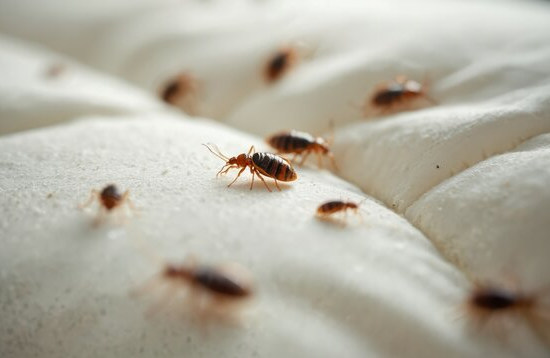
- A live bug. Adults are about the size and color of an apple seed — flat and oval when unfed, rounder and darker after feeding. Newly hatched nymphs are nearly translucent and very easy to miss.
- A sweet, musty odor in the room, which usually means a heavy, established population.
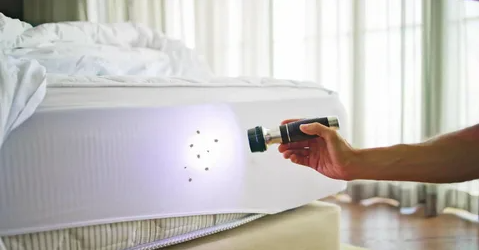
Bed bugs hide within a few feet of where people sleep, so that is where to look first: mattress and box spring seams, the bed frame and headboard, the nightstand, the carpet edge along the baseboard nearest the bed, and any upholstered chair someone regularly sleeps in. In heavier infestations they spread to outlet covers, picture frames, curtain hems, and closet items.
| What you found | Bed bug | Common look-alike |
|---|---|---|
| Apple-seed shaped, flat, reddish-brown | Yes — adult bed bug | Spider beetle is rounder and shiny |
| Fuzzy, carrot-shaped larva with bristles | No | Carpet beetle larva |
| Spots on mattress seams | Yes | Nothing else does this |
| Bugs found near an attic or chimney | Possibly | Bat bugs — means bats are roosting above |
| Bites only on ankles and lower legs | Unlikely | Fleas |
What Does Not Work
Before the list of what does work, it is worth naming the things that reliably waste money and often make the situation worse.
Money Wasters — Skip These
- Bug bombs and total-release foggers. The mist does not penetrate the cracks where bed bugs live. What it does is repel them deeper into wall voids and, in apartments, push them into neighboring units. This is the most common way a one-room problem becomes a whole-building problem.
- Throwing out the mattress. Bed bugs live in the frame, headboard, baseboards, and nightstand too. You lose the mattress, keep the bugs, and risk spreading them through the hallway on the way out.
- Rubbing alcohol and DIY sprays. These kill only what they directly soak, leave eggs untouched, and are a genuine fire hazard around beds.
- Sleeping in another room. Bed bugs follow the carbon dioxide. Moving to the couch typically spreads the infestation to the living room.
- Waiting to see if it gets better. A female lays a few eggs per day. Populations do not plateau on their own.
Reality Check
Every year we treat homes where the family already spent several hundred dollars on foggers, sprays and a new mattress. In almost every case the infestation was larger afterwards than before, because foggers scatter bed bugs into wall voids and adjoining rooms.
How Professional Bed Bug Treatment Works
A real treatment program is systematic, and it accounts for the egg stage, which is what nearly every DIY effort misses.
Inspection and scope
We start by confirming it is actually bed bugs carpet beetles, bat bugs, and spider beetles all get misidentified and then determining how far the infestation has spread.
That means the reported room plus adjoining rooms and, in shared housing, neighboring units. Treating too small an area is the leading cause of a treatment that seems to work and then fails three weeks later.
Preparation
You will get a written prep list, and following it closely is the difference between two visits and five. Typically it includes laundering and drying all bedding and clothing from the affected rooms on high heat, bagging the cleaned items, reducing clutter so harborage points are accessible, and pulling furniture away from the walls.
We keep prep as light as we reasonably can, because unrealistic prep lists lead to half-done prep.
Treatment
Depending on the situation we use a combination of methods. Targeted heat raises the temperature of a room or its contents past the lethal threshold and kills every life stage, including eggs, in a single session it is the fastest route for heavy infestations. Steam is used directly on mattress seams, tufting, and upholstery.
Precision residual products are placed in cracks and crevices, along baseboards, in bed frame joints, and in furniture voids where bed bugs travel, rather than sprayed across open surfaces. Mattress and box spring encasements trap anything remaining inside and make future monitoring far easier.
Follow-up
Except for full heat treatments, expect two or three visits spaced to intercept newly hatched nymphs before they can reproduce.
We also place interceptors and monitors so the follow-up visit is based on evidence rather than guesswork about whether activity has stopped.
How to Avoid Bringing Them Home
Travel & Second-Hand Checklist
- In hotels, pull back the sheet and check the mattress seams and headboard before unpacking, and keep luggage on the metal rack away from the bed and the wall rather than on the floor or the bed.
- On returning from any trip, run all clothing — worn or not — through a hot dryer cycle before it goes into drawers or closets.
- Inspect secondhand furniture, mattresses, and upholstered items carefully before they come in the door, and never take a mattress off a curb.
- In shared laundry rooms, transport clothes in sealed bags and fold at home, not on the communal table.
- Reduce clutter around beds and keep the perimeter of the mattress visible, which makes early detection realistic.
Get an Honest Answer Fast
If you suspect bed bugs, the worst thing you can do is spray something and wait. Call +1 (833) 425-2058 and we will confirm what you have, tell you the real scope, and give you a firm price before any work begins. Serving Crete, Chicago, Joliet, Naperville, Aurora, Rockford, Peoria, Springfield and communities throughout Illinois since 1980.
More detail on our approach is on the bed bug treatment in Illinois page, and for the bigger picture on insects and rodents in Illinois homes, read our complete guide to full-service pest control in Illinois.
Think You Have Bed Bugs?
We confirm what you actually have, tell you the real scope, and price the job before we start.