
Every August and September we get the same calls: someone mowed the lawn and hit a nest they never knew was there, or a nest above the front door has grown from a small comb in June to something nobody wants to walk under.
Stinging insects are the one pest category where getting it wrong can send someone to the emergency room, so it is worth knowing what you are looking at before you pick up a can of spray.
Quick Answer
Paper wasp nests are open and umbrella-shaped and relatively low risk. Yellow jackets nest hidden in the ground and in wall voids and are the most dangerous stinging insect in Illinois, peaking in August and September. Ground nests, void nests and bald-faced hornet nests should never be treated by a homeowner.
Know What You Are Dealing With
Yellow jackets
The most dangerous stinging insect in Illinois, mainly because of where they nest. Yellow jackets build in the ground, in old rodent burrows, in wall voids, behind soffits and siding, and under decks, sheds, and porch steps. The nest is usually invisible you find it by disturbing it.
They are highly aggressive in defense of the colony, each worker can sting repeatedly, and they attack in numbers. Colonies build all summer to peak size in August and September, which is when workers also turn scavenger and start appearing around trash cans, open drinks, grills, and picnic tables.
Paper wasps
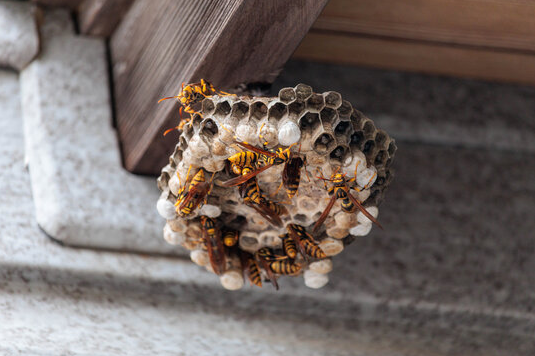
These build the familiar open, umbrella-shaped comb with visible cells, hanging under eaves, porch ceilings, deck rails, playsets, grill lids, mailboxes, and light fixtures.
They are much less aggressive than yellow jackets and will generally only defend within a few feet of the nest but a nest beside a doorway, a child play area, or a frequently used walkway is still a genuine hazard.
Bald-faced hornets
The large enclosed gray nest, shaped like a football or teardrop, hanging in a tree or attached to a structure.
Bald-faced hornets are extremely defensive and can spray a defensive fluid toward the eyes. Nests can hold hundreds of workers. These should always be handled with professional protective equipment, never from a ladder with a store-bought can.
Carpenter bees
Large, bumblebee-like, and mostly harmless — males hover aggressively but cannot sting. The problem is structural: they drill perfectly round, half-inch holes into untreated wood such as deck rails, fascia, pergolas, and shed trim to nest. Galleries get reused and extended each year, and woodpeckers tear open the wood to reach the larvae, which is where the expensive damage happens. See our carpenter bee control page.
Honey bees Leave These Alone
If the insects are fuzzy, golden brown, and working flowers, and especially if you find a colony with wax comb inside a wall or tree, it is likely honey bees.
Honey bees are valuable pollinators and are not treated as a pest. The right response is removal and relocation by a beekeeper, not extermination, and we will tell you that rather than treat them.
| Species | Nest looks like | Risk level | Safe to DIY |
|---|---|---|---|
| Yellow jacket | Hidden — ground, wall void, under decking | Very high — aggressive, stings repeatedly | No |
| Paper wasp | Open umbrella comb under eaves | Moderate — defends within a few feet | Small nests only, early season |
| Bald-faced hornet | Large enclosed grey football in a tree | Very high — extremely defensive | No |
| Carpenter bee | Round half-inch holes in bare wood | Low — males cannot sting | Prevention yes, galleries no |
| Honey bee | Wax comb in a wall or tree cavity | Low — beneficial pollinator | Call a beekeeper, not an exterminator |
When You Can Handle It and When You Should Not
A small paper wasp nest, no bigger than a golf ball, in an open and easily reachable spot, early in the season, treated at dusk from the ground with a proper jet-spray product and a clear escape path behind you, is within reason for a careful homeowner.
Call a professional if any of the following apply:
Call a Professional If
- The nest is in the ground, in a wall void, behind siding or soffit, or anywhere the entrance leads somewhere you cannot see.
- It is a bald-faced hornet nest or a yellow jacket colony of any size.
- The nest requires a ladder to reach. Falls during wasp treatment are more common than stings.
- Anyone in the household has a known sting allergy, carries an epinephrine auto-injector, or has a heart or respiratory condition.
- The nest is near a door, deck, walkway, playset, or anywhere children and pets pass regularly.
- It is late summer and the colony is large and active, with steady traffic in and out.
- You have already sprayed it once and the colony is still active, which means the insects are now agitated and the nest is still viable.
Things People Try That Go Badly
What Goes Badly — Avoid These
- Gasoline or boiling water into a ground nest. Dangerous, environmentally damaging, and it rarely reaches the whole nest. What it reliably produces is a swarm of angry yellow jackets at ground level.
- Spraying a wall void entrance from outside. Treating the opening without treating the void can drive the colony to chew inward through drywall and emerge inside the house.
- Plugging the entry hole while the colony is alive. Same outcome. They find another way, often into the living space.
- Knocking a nest down with a broom or hose. This does not kill the colony, it just triggers a defensive response with you standing directly beneath it.
- Treating in the middle of a sunny afternoon. Most of the colony is out foraging, so you kill a fraction and the returning workers rebuild.
How Professional Stinging Insect Removal Works
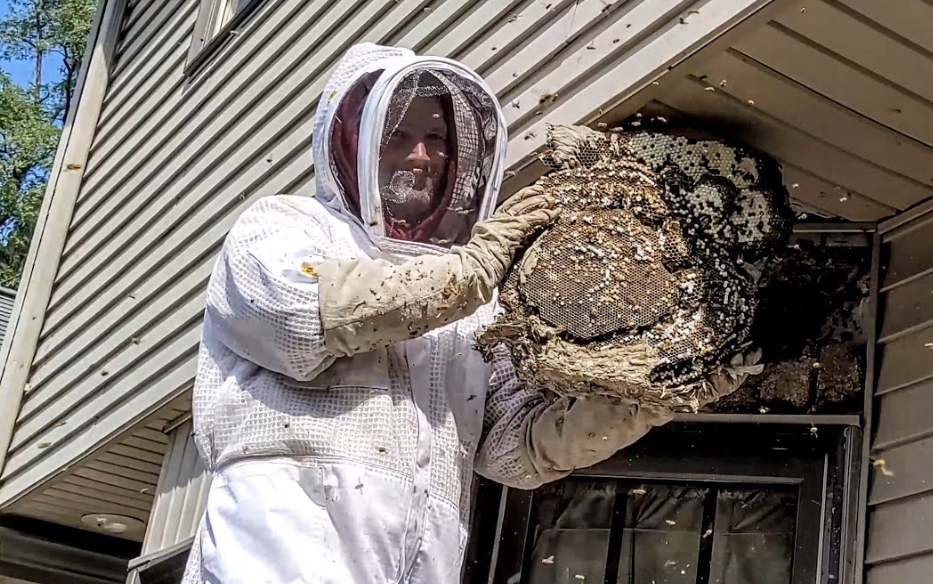
The first step is locating the true nest, which is not always where the activity appears. Insects entering a soffit at the corner of a house may be nesting several feet inside.
We watch traffic patterns and, for void nests, use that to determine where the colony actually sits before treating.
Treatment is direct and matched to the nest type: an appropriate dust formulation blown into a ground or void nest so workers track it through the colony, or a direct aerosol application for exposed combs.
Timing is deliberate dusk or early morning, when nearly the whole colony is home and activity is lowest. Technicians wear proper protective equipment, and we ask that people and pets, particularly anyone with a sting allergy, stay clear of the area during and immediately after treatment.
After the colony is confirmed dead we physically remove exposed combs so the site is not immediately reused, seal void and ground entry points, and apply a residual to the eaves, soffits, rails, and other protected surfaces that queens favor for rebuilding.
That last part is what keeps you from repeating the same call next summer. Details are on our wasp removal and yellow jacket control pages.
Timing Matters
A nest treated in May is a queen and a handful of workers. The same nest in late August holds hundreds or thousands. Early-season treatment is dramatically safer and cheaper — and it is why we recommend an eaves-and-soffit check every spring.
Prevention Before the Season Starts
Prevention Checklist
- Have the eaves, soffits, deck rails, and playsets inspected and treated in May and June, when nests are still a queen and a few workers. Early treatment is dramatically safer and cheaper.
- Seal gaps in siding, soffit returns, brick weep holes, and around utility penetrations before spring.
- Keep garbage and recycling in bins with tight lids, rinse cans and bottles, and move bins away from doors and patios.
- Cover food and drinks at outdoor gatherings, and use covered cups — most late-summer stings happen when someone drinks from an open can a yellow jacket has entered.
- Fill abandoned rodent burrows in the yard, since yellow jackets readily take them over.
- Check mailboxes, grill covers, light fixtures, and unused planters in early summer, which are favorite spots for small paper wasp nests.
Same-Day Stinging Insect Service Across Illinois
A nest by your front door or under your deck is not something to live with, and it is not worth risking a fall or a swarm of stings. Call +1 (833) 425-2058 for same-day service Which is available across the Chicago metro and throughout Illinois. Locally owned in Crete since 1980.
For the full picture on insects and rodents through the Illinois seasons, read our complete guide to full-service pest control in Illinois.
Nest by Your Door or Under the Deck?
Same-day stinging insect removal across the Chicago metro and throughout Illinois.